



Model, Deploy, Orchestrate, and Optimize Cloud Applications and Infrastructure
— Preview
Strategy based on a significant abstraction of the application structure description, in order to further automate application and infrastructure management.
Christian Perez, Inria Research Director
Keywords : Cloud, Edge, IoT, Computation Continuum, model, verification, deployment, reconfiguration, orchestrator, optimisatin
New infrastructures, such as Edge Computing or the Cloud-Edge-IoT computing continuum, make cloud issues even more complex, as they add new challenges linked to the diversity and heterogeneity of resources (from small sensors to data centers/HPCs, from low-power networks to core networks), geographical distribution, as well as increased requirements for dynamicity and security, all under constraints such as energy consumption.
To exploit these new infrastructures efficiently, the Taranis project is based on a strategy aimed at abstracting the description of the structure of applications and resources in order to automate their management even further. In this way, it will be possible to globally optimize the resources used with regard to multi-criteria objectives (price, deadline, performance, energy, etc.) on both the user side (applications) and the resource provider side (infrastructures). Taranis also addresses the challenges of abstracting application reconfiguration and dynamically adapting resource usage.
— Missions
— Our researches
The Taranis project addresses this issue via four scientific work packages, each focusing on a phase of the application lifecycle: application description model and infrastructure, deployment and reconfiguration, orchestration and optimization. Work package 0 is dedicated to project management.
— Partners
Consortium
Inria, CNRS, IMT, UGA, CEA, Université de Rennes, ENS Lyon, Université Claude Bernard Lyon 1, Université de Lille, INSA Rennes
— Research team
48 permanent staff (not funded by the project)
46 people funded by the project, including:
27 PhD students
7 post-docs
12 engineers
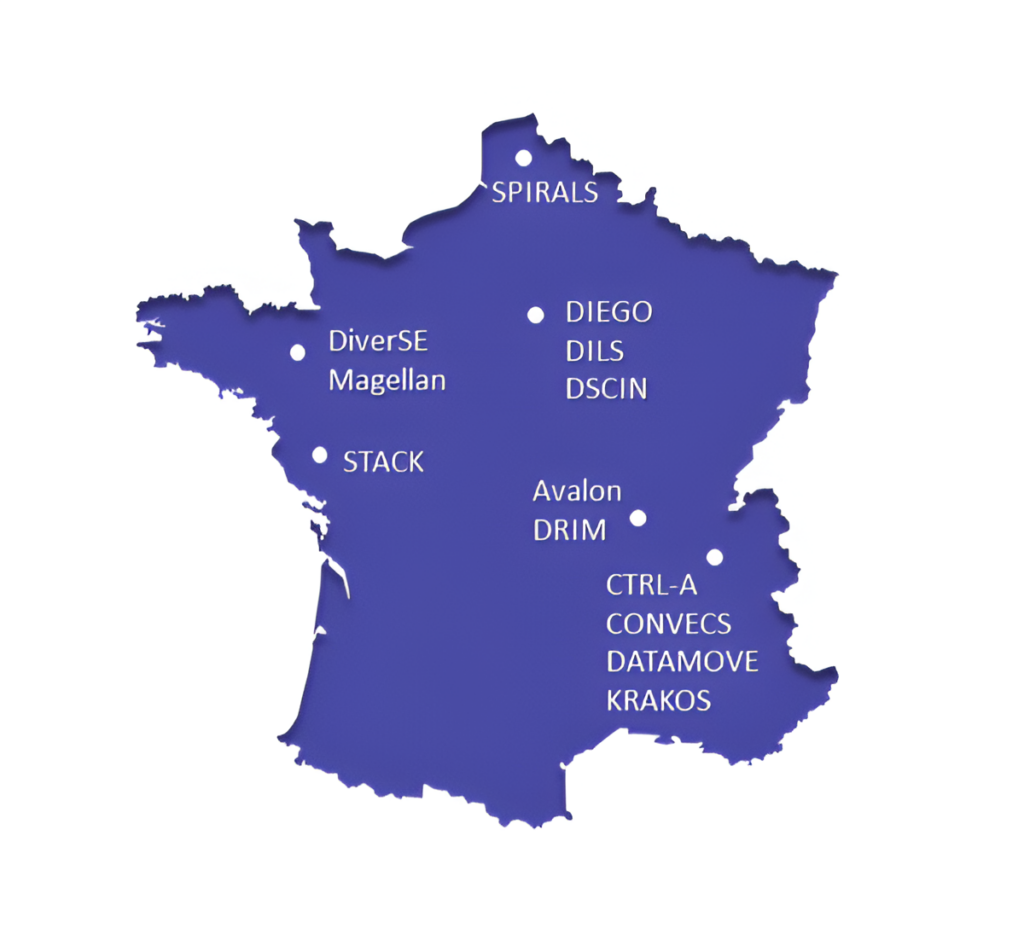
Our teams in France
— Publications

Articles dans une revue
- Fatima Elhattab, Sara Bouchenak, Cédric Boscher. PASTEL: Privacy-Preserving Federated Learning in Edge Computing. Proceedings of the ACM on Interactive, Mobile, Wearable and Ubiquitous Technologies , 2024, 7 (4), pp.1-29. ⟨10.1145/3633808⟩. ⟨hal-04394133⟩
Communications dans un congrès
- Brell Sanwouo, Paul Temple, Clément Quinton. Dynamic Agent Generation for Self-Adaptive Root Cause Analysis. SEAMS'26 - 21st International Conference on Software Engineering for Adaptive and Self-Managing Systems, Apr 2026, Rio de Janeiro, Brazil. ⟨hal-05402186⟩
- Pierre Bourhis, Cristian Riveros, Amaranta Salas. A formal query language and automata model for aggregation in complex event recognition. ICDT 2026 - 29th International Conference on Database Theory, Mar 2026, Tampere, Finland. ⟨hal-05482197⟩
- Wided Meflah, Hayet Brabra, Mehdi Acheli, Hosni Ben Douma, Mohamed Sellami, et al.. From natural language to TOSCA: leveraging LLMs for automated service composition. International Conference on Service-Oriented Computing (ICSOC), Dec 2025, Shenzen, China. pp.3-18, ⟨10.1007/978-981-95-5012-8_1⟩. ⟨hal-05456614⟩
- Danny de Novi, Lorenzo Carnevale, Daniel Balouek-Thomert, Manish Parashar, Massimo Villari. Predictive Resource Management in the Computing Continuum: Transfer Learning from Virtual Machines to Containers using Transformers. UCC 2025 - IEEE/ACM 18th International Conference on Utility and Cloud Computing, Dec 2025, Nantes, France. pp.1-8, ⟨10.1145/3773274.3774856⟩. ⟨hal-05468841⟩
- Martin Molli, Daniel Balouek, Paul Temple, Thomas Ledoux. Event-Driven Adaptation in the Computing Continuum Using Software Variability. UCC 2025 - IEEE/ACM 18th International Conference on Utility and Cloud Computing, Dec 2025, Nantes, France. pp.1-2, ⟨10.1145/3773274.3774672⟩. ⟨hal-05379151⟩
- Philippe Merle, Fabio Petrillo. Visualizing Cloud-native Applications with KubeDiagrams. VISSOFT 2025 - 13th IEEE Working Conference on Software Visualization, Sep 2025, Auckland, New Zealand. pp.106 - 116, ⟨10.1109/VISSOFT67405.2025.00022⟩. ⟨hal-05263068⟩
- Brell Sanwouo, Paul Temple, Clément Quinton. Generative AI-based Adaptation in Microservices Architectures: A Systematic Mapping Study. ICWS'25 - International Conference on Web Services, Jul 2025, Helsinki, Finland. pp.1-8. ⟨hal-05082732v2⟩
- Martin Molli, Daniel Balouek, Paul Temple, Thomas Ledoux. Facilitating Heterogeneity Management on the Computing Continuum. COMPAS 2025 - Conférence francophone d'informatique en Parallélisme, Architecture et Système, Jun 2025, Bordeaux, France. pp.1-8. ⟨hal-05138189⟩
- Nawel Benarba, Mathieu Chevalier, Sara Bouchenak, Benjamin Bertin, Olivier Jung. Anomaly Detection in Energy Performance Certificates – From Oblivious to Enlightened. 2025 55th Annual IEEE/IFIP International Conference on Dependable Systems and Networks - Supplemental Volume (DSN-S), Jun 2025, Naples, Italy. pp.8-14, ⟨10.1109/DSN-S65789.2025.00035⟩. ⟨hal-05252374⟩
- Brell Peclard Sanwouo, Clément Quinton, Paul Temple. Breaking the Loop: AWARE is the new MAPE-K. FSE'25 - ACM International Conference on the Foundations of Software Engineering, Jun 2025, Trondheim, Norway. pp.626-630, ⟨10.1145/3696630.3728512⟩. ⟨hal-04992342⟩
- Dominik Huber, Sergio Iserte, Martin Schreiber, Antonio J. Peña, Martin Schulz. Bridging the Gap Between Genericity and Programmability of Dynamic Resources in HPC. ISC High Performance 2025 - 40th ISC High Performance International Conference, Jun 2025, Hamburg, Germany. pp.1-11. ⟨hal-04994828⟩
- Cédric Boscher, Nawel Benarba, Fatima Elhattab, Sara Bouchenak. Personalized Privacy-Preserving Federated Learning. Proceedings of the 25th International Middleware Conference, Dec 2024, Hong Kong, China. pp.454--466, ⟨10.1145/3652892.3700785⟩. ⟨hal-04770214⟩
- Yasmine Djebrouni, Isabelly Rocha, Sara Bouchenak, Lydia Chen, Pascal Felber, et al.. Characterizing Distributed Machine Learning Workloads on Apache Spark. Middleware '23: 24th International Middleware Conference, Dec 2023, Bologna, Italy. pp.151-164, ⟨10.1145/3590140.3629112⟩. ⟨hal-04399409⟩
Autres publications
- Yasmine Djebrouni, Vania Marangozova, Sara Bouchenak. Dataset for Characterizing Distributed Machine Learning Workloads on Apache Spark. 2024, ⟨10.5281/zenodo.14151075⟩. ⟨hal-04781721⟩
Documents récupérés de l'archive ouverte HAL 
Other projects
Archi-CESAM
Efficient and safe converged architecture based on near-memory gas pedals / Archi-CESAM

CARECloud
Understanding, improving and reducing the environmental impact of cloud computing
DiVa
Virtualized disaggregation

SILECS
Super Infrastructure for Large-Scale Experimental Computer Science for Cloud/Edge/IoT
PEPR Cloud Projects
SPIREC
Multi-level supervision and prediction for geo-distributed and heterogeneous infrastructures in the Cloud/Edge/IoT continuum
STEEL
Efficient and secure data storage and processing on cloud-based infrastructures
TARANIS
Model, deploy, orchestrate and optimize cloud applications and infrastructures

TrustinCloudS
Cloud infrastructure security